


 /
/ 

SUMO Protease is derived from Saccharomyces cerevisiae and recombinantly expressed in Escherichia coli. It recognizes the tertiary structure of the ubiquitin-like SUMO domain and cleaves the peptide bond immediately after the Gly-Gly motif in the X‑Gly‑Gly‑X sequence at the C‑terminus of the SUMO domain. In addition to naturally SUMO-modified proteins, this enzyme is also used for cleaving recombinant SUMO fusion proteins.
The optimal pH for SUMO Protease cleavage is 8.0, and the optimal temperature is 30 °C. It maintains high enzymatic activity over a pH range of 6.0–10.0, a temperature range of 2–30 °C, and an ionic strength range of 0–400 mM NaCl. Furthermore, its cleavage activity is enhanced in the presence of 0.5–2 mM DTT as a reducing agent. Adding an appropriate concentration of DTT to the digestion system significantly improves cleavage efficiency, especially during prolonged digestion, such as overnight incubation at 4 °C.
Applications
Cleavage of the SUMO fusion tag during purification.
Advantages
(1) No extra amino acid residues remain after SUMO tag removal.
(2) High specificity, as it only recognizes and cleaves the three-dimensional structure of SUMO protein.
(3)Compatible with a wide range of pH, temperature and reaction conditions.
(4)The enzyme carries a 6-His tag and can be easily removed by nickel column purification after digestion.
Information
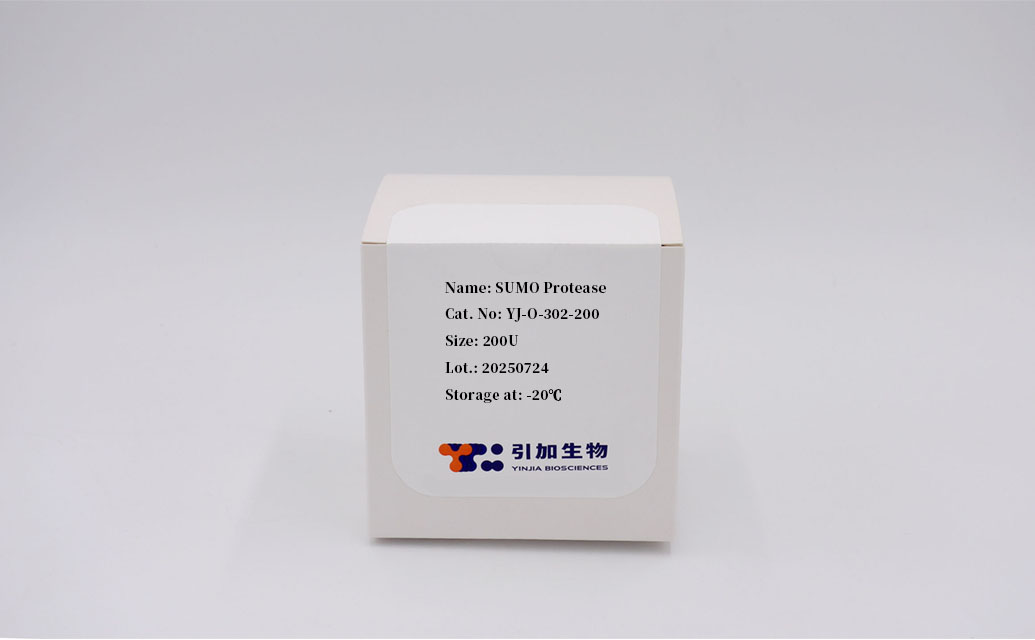
(1)Product Name: SUMO Protease
(2)Catalog No. : YJ-O-302
(3)Size: 200 U / 1 KU / 5 KU
(4)Storage temperature: -20 ℃